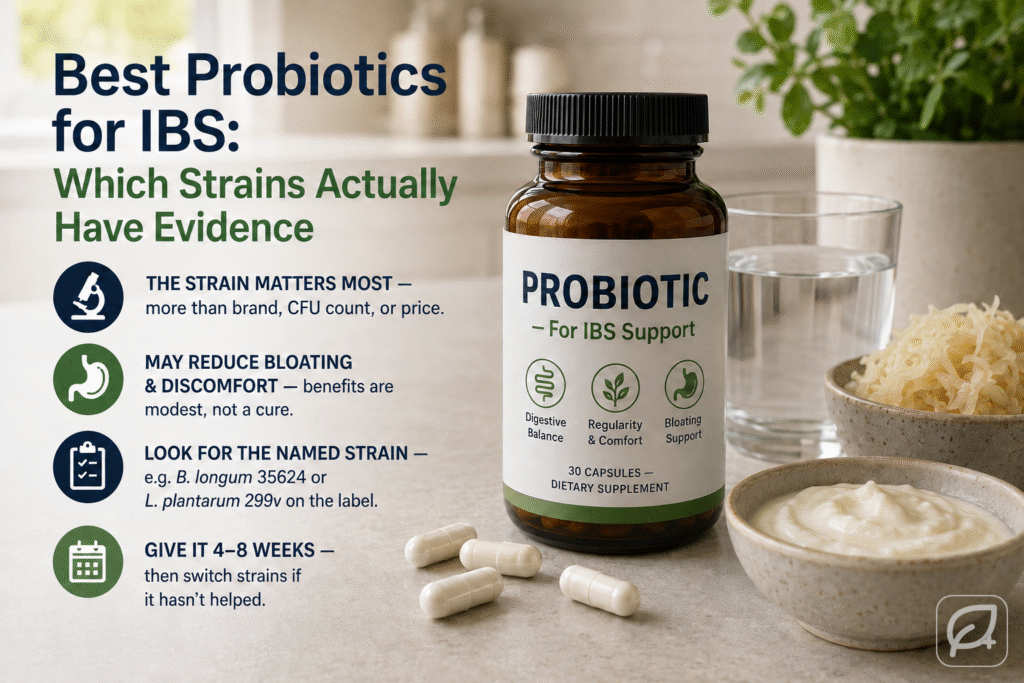
If you’re shopping for a probiotic to help with IBS, the single most important thing to know is this: the specific strain matters far more than the brand, the CFU count, or the price. Probiotic benefits are strain-specific — a strain proven to help IBS symptoms in studies is what you’re paying for, not just “probiotics” in general. For the full background, see our guide on whether probiotics help IBS.
How we chose these: we prioritized strains with published clinical research in IBS populations, products that clearly disclose the exact strain (not just a genus), and brands that guarantee viable CFU counts through the expiration date. We do not physically test products — see our editorial policy. And a realistic expectation to set up front: even the best-studied strains show a moderate effect at best, not a cure.
The strains with the strongest IBS evidence
Bifidobacterium longum 35624 — best-documented for overall symptoms
This trademarked strain (found in Align) has among the most consistent research for overall IBS symptom relief, including bloating, gas, and abdominal discomfort, across several controlled trials. It’s a sensible starting point if your symptoms are general rather than one specific complaint. We covered it in depth in our Align Probiotic review — including the honest caveat that its dose-response evidence is mixed.
Lactobacillus plantarum 299v — strong data for pain and bloating
This strain has notable evidence for reducing abdominal pain and bloating, particularly in post-infectious IBS. In one double-blind, placebo-controlled trial of 214 IBS patients, about 78% rated it “good or excellent” for symptom relief versus 8% for placebo. It’s sold in single-strain products (look for “299v” or “DSM 9843” on the label).
Lactobacillus rhamnosus GG — the most-studied strain overall
Found in Culturelle, L. rhamnosus GG is one of the most researched probiotic strains in existence, backed by a very large body of studies. Its IBS-specific evidence is less targeted than the two above, but it’s a well-characterized, reliably manufactured option, and Culturelle guarantees its CFU count is viable through the expiration date.
Saccharomyces boulardii — for diarrhea-predominant IBS
This is a beneficial yeast (not a bacterium), with evidence oriented toward managing diarrhea rather than IBS symptoms broadly. If your IBS is diarrhea-predominant (IBS-D), it’s worth knowing about.
High-CFU multi-strain blends (e.g., VSL#3)
Some high-potency, multi-strain formulas such as VSL#3 (a very high-CFU medical-grade blend) have been studied for digestive conditions including IBS. These are more intensive (and pricier) options often used under medical guidance rather than as a first try.
How to actually choose
- Match the strain to your symptom. General symptoms → B. longum 35624. Pain/bloating (especially post-infection) → L. plantarum 299v. Diarrhea-predominant → S. boulardii.
- Look for the named strain on the label (e.g., “Bifidobacterium longum 35624”), not just “Lactobacillus blend.” If a product won’t tell you the exact strain, you can’t match it to any evidence.
- Check for a viability guarantee through the expiration date — CFU count at manufacture means little if the bacteria are dead by the time you take them.
- Give it time. Trials typically run 4–8 weeks. If a strain hasn’t helped after a fair trial, switching to a different evidence-backed strain is more sensible than adding more of the same.
And the honest bottom line: probiotics help some people with IBS, modestly. If your symptoms are significant or persistent, that’s a conversation for a doctor, not a supplement-aisle decision.
This article is researched and fact-checked against peer-reviewed studies and government health databases (NIH, PubMed). It is not written or reviewed by a licensed medical professional, and it is not a substitute for personalized medical advice — talk to your doctor about IBS symptoms, especially if they are severe, persistent, or accompanied by other concerning symptoms. People who are immunocompromised or seriously ill should not start probiotics without medical guidance.
Sources: NIH PMC: Efficacy of Probiotics for Irritable Bowel Syndrome, NIH PMC: Outcome-Specific Efficacy of Probiotic Strains in IBS