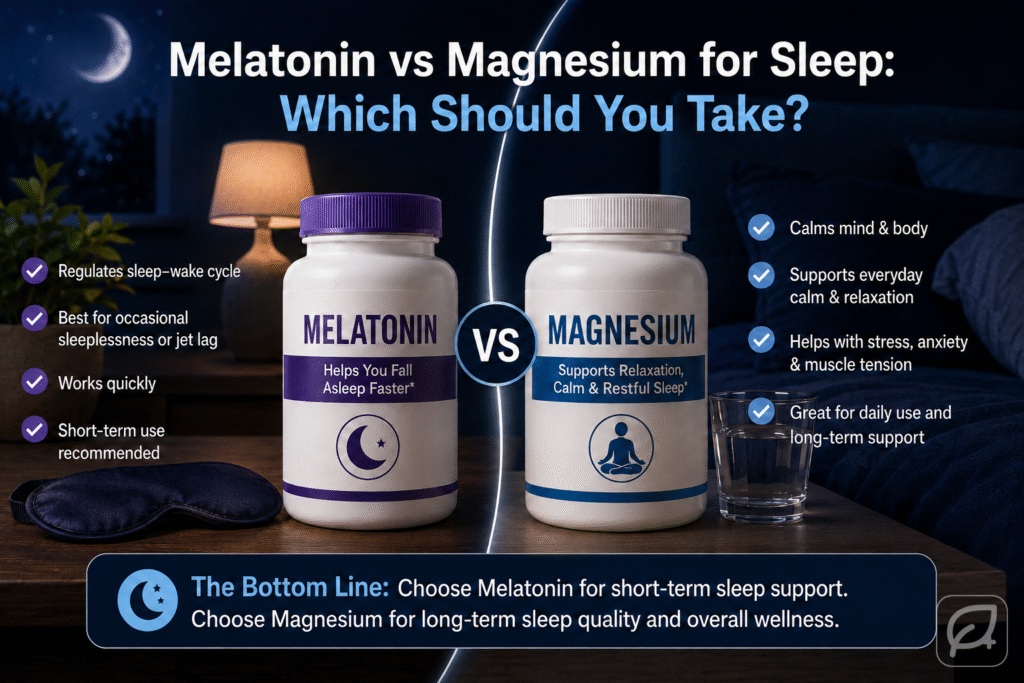
Melatonin and magnesium are the two supplements people reach for most when they can’t sleep — and they’re often treated as interchangeable. They’re not. They work through completely different mechanisms and suit different sleep problems. Here’s the short version:
- Melatonin is a timing signal — best for trouble falling asleep, jet lag, and shift work.
- Magnesium is a calming mineral — best for general relaxation and everyday sleep support, taken consistently.
How each one works
Melatonin is a hormone your body makes in the evening to signal that it’s time to sleep — it sets your internal clock (circadian rhythm). Taking it as a supplement mainly helps you fall asleep faster and shift your sleep timing. It doesn’t sedate you; it tells your body “it’s night.”
Magnesium is an essential mineral involved in muscle relaxation, nerve function, and the neurotransmitters tied to calm and stress. Rather than flipping a “sleep now” switch, it supports the body’s overall relaxation systems. For sleep specifically, the glycinate form is the usual choice — see our glycinate vs citrate comparison for why.
Which works better for sleep?
For simply falling asleep faster, melatonin has the stronger and more direct evidence — it’s well studied for reducing the time it takes to drift off. But “better” depends on your problem. Melatonin is most useful when your sleep timing is off (you go to bed but can’t fall asleep, or you’re jet-lagged). Magnesium is more of a background, general-calm supplement that works best taken consistently over days to weeks rather than as an on-the-spot sleep aid.
Notably, the American Academy of Sleep Medicine supports melatonin for sleep-timing problems like jet lag and shift-work disorder — not as a treatment for chronic insomnia. If your sleeplessness is persistent, neither supplement is a substitute for seeing a doctor.
When to use each
- Melatonin: a low dose (many experts suggest starting around 0.5–3 mg, and often no more than 5 mg) taken 30–60 minutes before bed. Higher isn’t better — more melatonin doesn’t mean more sleep, and can cause grogginess.
- Magnesium: can be taken any time of day, but consistency matters — you’re topping up your body’s stores. Some people notice a difference within days; allow a few weeks for the full effect. Keep supplemental magnesium at or below the 350 mg/day adult upper limit.
Can you take both?
Yes — they act through different pathways, so many people combine them: magnesium for general calm and melatonin for sleep onset. They may complement each other. As always, check with a doctor or pharmacist first if you take other medications, and note that melatonin in particular can interact with some drugs and isn’t advised for certain conditions.
Bottom line
If your main problem is falling asleep or your schedule is off, start with melatonin. If you’re after everyday relaxation and steadier sleep and prefer a gentler, non-hormonal option, go with magnesium (glycinate). And you can use both if one alone isn’t enough. For the fuller picture on non-melatonin options, see our guide on natural sleep aids vs melatonin.
This article is researched and fact-checked against peer-reviewed studies and government health databases (NIH, PubMed). It is not written or reviewed by a licensed medical professional, and it is not a substitute for personalized medical advice — talk to your doctor before starting a sleep supplement, especially if you take medication or have a health condition. See how we review.
Sources: Sleep Foundation: Natural Sleep Aids, NIH ODS Magnesium Fact Sheet