Ashwagandha (Withania somnifera) is an adaptogenic herb used in Ayurvedic medicine for centuries, and it’s become one of the most popular supplements for stress and sleep in the last decade. Its active compounds, called withanolides, are believed to be behind most of its effects — but it’s also a herb with real contraindications that are worth understanding before you take it.
What the evidence actually shows
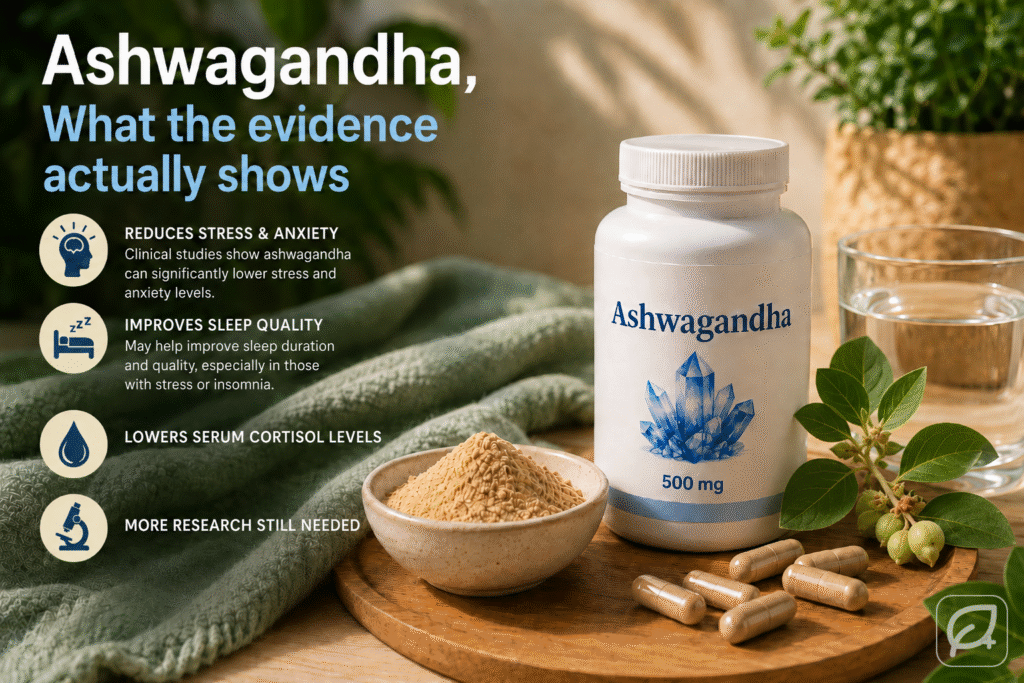
Several randomized, placebo-controlled clinical studies have found that ashwagandha root extract reduces self-reported stress and anxiety, lowers serum cortisol levels, and improves sleep quality compared with placebo. A World Federation of Societies of Biological Psychiatry taskforce has provisionally (not strongly) recommended specific doses of ashwagandha root extract for generalized anxiety disorder, while noting more research is still needed.
Dosage
Clinical studies have used doses ranging from 240 mg to 1,250 mg/day of root extract (some studies used up to 12,000 mg/day of whole root granules, equivalent to about 6,000 mg of root powder). Across multiple studies, benefits tended to be more consistent at 500–600 mg/day of extract than at lower doses.
Safety and who should avoid it
Ashwagandha is generally well tolerated at studied doses, with mild digestive upset being the most common side effect. Rare cases of liver injury have been reported at very high doses. More importantly, there are specific groups who should avoid it or use it only under medical supervision:
- Pregnancy — ashwagandha should be avoided during pregnancy. Traditional Ayurvedic texts list it as an abortifacient, and current safety guidance recommends avoiding it entirely.
- Breastfeeding — avoid due to insufficient safety data.
- Thyroid conditions — ashwagandha can stimulate thyroid hormone activity. If you have hyperthyroidism or Graves’ disease, or take levothyroxine or another thyroid medication, adding ashwagandha could push thyroid levels too high.
- Autoimmune conditions — because ashwagandha may stimulate immune activity, it could potentially worsen autoimmune conditions such as rheumatoid arthritis, lupus, or Hashimoto’s thyroiditis.
Medication interactions to know:
- Diabetes medications — ashwagandha may lower blood sugar further, increasing the risk of hypoglycemia when combined with antihyperglycemic drugs.
- Blood pressure medications — may have an additive blood-pressure-lowering effect.
- Immunosuppressants — ashwagandha’s immune-stimulating effect may work against these medications.
- Sedatives and anti-seizure medications — combined sedative effects are possible.
- Thyroid hormone medications — see above; this combination should only be used under medical supervision.
This article is researched and fact-checked against peer-reviewed studies and government health databases (NIH National Center for Complementary and Integrative Health, PubMed). It is not written or reviewed by a licensed medical professional, and it is not a substitute for personalized medical advice — talk to your doctor or pharmacist before starting ashwagandha, especially if you are pregnant, breastfeeding, have a thyroid or autoimmune condition, or take any medication. See how we review.
Sources: NIH ODS Ashwagandha Fact Sheet for Health Professionals, NIH NCCIH: Ashwagandha Usefulness and Safety, Merck Manual Professional Edition: Ashwagandha