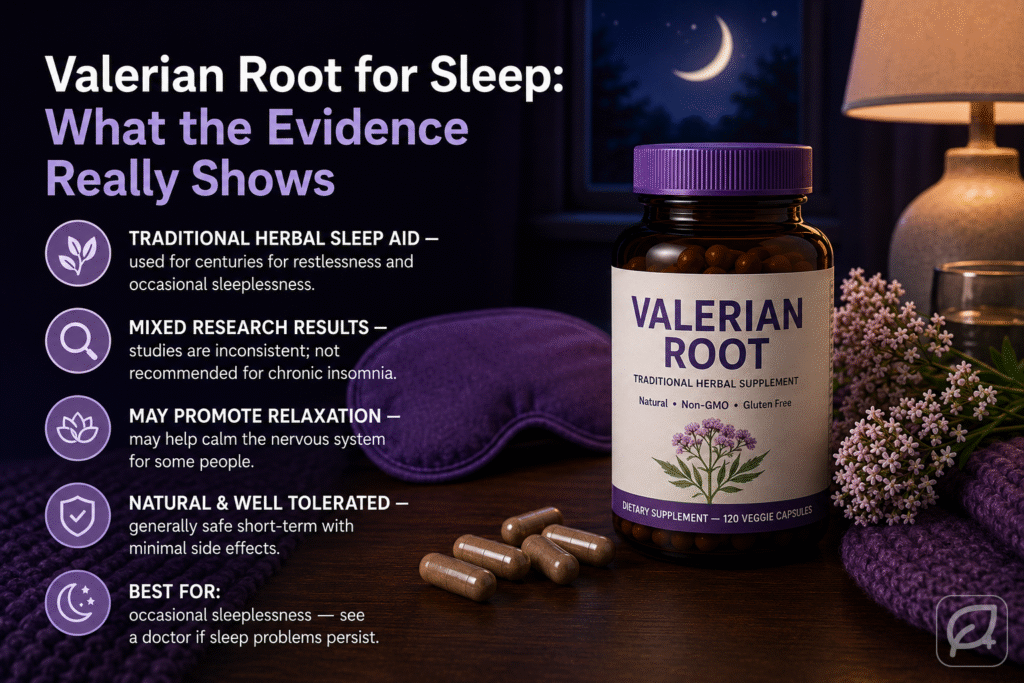
Valerian root (Valeriana officinalis) has been used as a calming herb since ancient Greece, and today it’s one of the most common ingredients in “natural sleep” blends. The honest summary up front: it’s generally safe for short-term use, but the evidence that it actually improves sleep is inconsistent — weaker than melatonin’s and weaker than many labels imply.
What the evidence shows
Study results on valerian are genuinely mixed. Some trials and meta-analyses suggest modest improvements in subjective sleep quality, while others find no meaningful difference from placebo — and the studies vary widely in valerian preparations, doses, and quality, which makes firm conclusions hard. Notably, the American Academy of Sleep Medicine recommends against valerian for chronic insomnia in adults. If it helps, the effect is likely mild and may take a few weeks of consistent use to appear, rather than working the first night.
Dosage
Clinical studies have most commonly used 300–600 mg of valerian root extract, taken 30–60 minutes before bed, with apparent safety for up to about six weeks of use. As with most herbs, products vary a lot — standardized extracts from brands with third-party testing are the safer bet (see how we evaluate supplements).
Side effects and safety
Valerian is generally well tolerated short-term. Reported side effects include headache, stomach upset, mental dullness or next-day grogginess, and — paradoxically, in some people — excitability or uneasiness. Vivid dreams also show up in reports. Long-term safety hasn’t been well studied.
Who should avoid it
- Anyone taking sedatives, sleep medications, or anti-anxiety drugs — valerian can stack with them and become overly sedating. The same applies to alcohol.
- Pregnant or nursing women — insufficient safety data.
- Young children — not recommended.
- Stop valerian a couple of weeks before scheduled surgery, since it can interact with anesthesia — and tell your surgical team about all supplements you take.
How it compares to the alternatives
Among the sleep supplements we’ve covered, valerian sits at the weaker end of the evidence spectrum: melatonin has stronger data for sleep timing (see our melatonin guide), magnesium glycinate is the gentler daily-relaxation option (see best magnesium for sleep), and ashwagandha and L-theanine have their own calm-oriented evidence. Valerian is a reasonable “worth a try” for mild, occasional sleeplessness if those options don’t suit you — with expectations set accordingly.
This article is researched and fact-checked against peer-reviewed studies and government health databases (NIH, PubMed). It is not written or reviewed by a licensed medical professional, and it is not a substitute for personalized medical advice — talk to your doctor before starting valerian, especially if you take any sedating medication.
Sources: NIH NCCIH: Valerian — Usefulness and Safety, NIH PMC: Valerian Root in Treating Sleep Problems — Systematic Review, Mayo Clinic: Valerian for insomnia?