Vitamin B12 is essential for nerve function, red blood cell formation, and DNA synthesis — and it’s unusual among vitamins in two ways: deficiency is common in specific, predictable groups, and toxicity is essentially a non-issue. That combination makes B12 one of the most clearly justified supplements for the right people.
Who actually needs B12 supplements
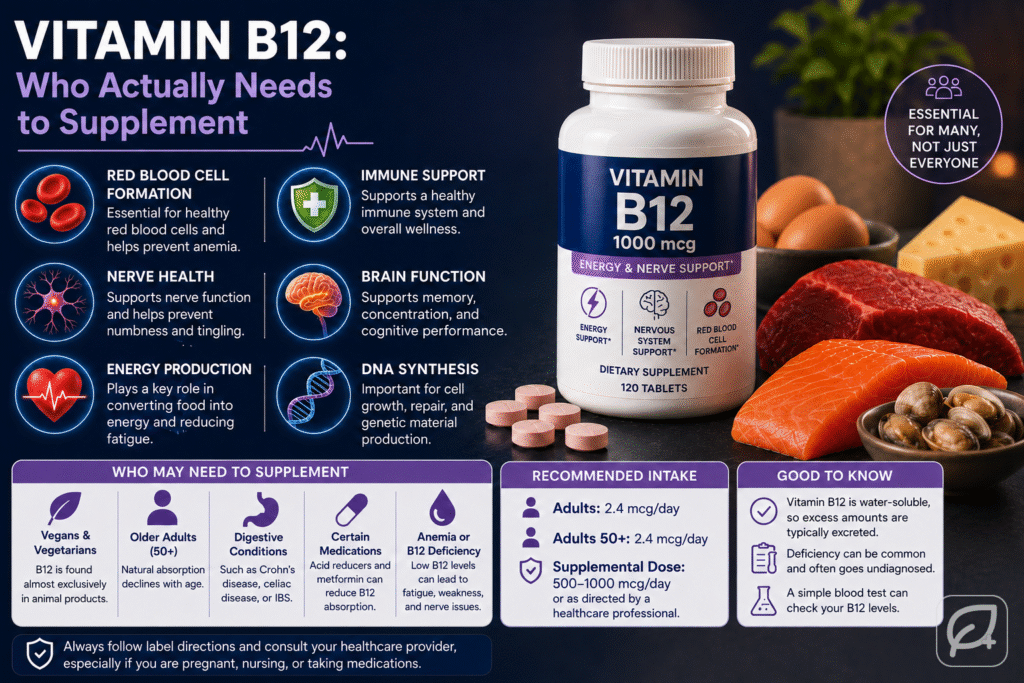
B12 occurs naturally only in animal foods (meat, fish, eggs, dairy), and absorbing it requires stomach acid and a protein called intrinsic factor. That’s why the at-risk groups are so predictable:
- Vegans and most vegetarians — fortified foods and supplements are the only reliable B12 sources on a plant-based diet. Deficiency among unsupplemented vegans is well documented.
- Adults over ~60 — stomach acid production declines with age, reducing absorption from food (crystalline B12 in supplements absorbs fine).
- People on long-term metformin — the common diabetes drug lowers B12 levels by roughly 14–30% over time; periodic B12 checks are increasingly recommended for long-term users.
- People on acid-reducing drugs (PPIs like omeprazole, H2 blockers) — less stomach acid, less absorption from food.
- People with GI conditions or surgery — celiac, Crohn’s, gastric bypass, pernicious anemia (which requires medical treatment, not shelf supplements).
Deficiency symptoms build slowly: fatigue, numbness or tingling, memory trouble, and a characteristic anemia. Left long enough, nerve damage can become permanent — which is why the at-risk groups shouldn’t wait for symptoms.
How much, and which form
The RDA is small — 2.4 mcg/day for adults — but supplement doses are much higher (typically 250–1,000 mcg) because only a small fraction is absorbed without intrinsic factor. That’s by design, not overdosing: B12 has no established upper limit, as excess is excreted and no toxicity threshold has been identified.
On forms: cyanocobalamin is the most studied, most stable, and cheapest form and is the sensible default; methylcobalamin is marketed as “more natural” but both effectively raise B12 levels. Don’t pay a premium on form alone.
Interactions and practical notes
- The drugs that matter mostly work by reducing B12 (metformin, PPIs) rather than interacting dangerously with it.
- Very high B12 blood levels can mask certain lab findings, and folate/B12 deficiencies can mimic each other — another reason a blood test beats guessing.
- If you suspect deficiency, get tested rather than self-treating — pernicious anemia and neurological symptoms need medical management.
Bottom line
If you’re vegan, over 60, or on long-term metformin or acid reducers, a basic cyanocobalamin supplement (or reliably fortified foods) is cheap, safe, and well justified. If you’re a healthy omnivore, you almost certainly don’t need it — B12 in a multivitamin is plenty.
This article is researched and fact-checked against peer-reviewed studies and government health databases (NIH Office of Dietary Supplements, PubMed). It is not written or reviewed by a licensed medical professional, and it is not a substitute for personalized medical advice — talk to your doctor if you suspect B12 deficiency, especially if you have numbness, tingling, or memory changes. See how we review.
Sources: NIH ODS Vitamin B12 Fact Sheet for Health Professionals, NIH PMC: Prevalence of B12 Deficiency with Long-Term Metformin, NIH PMC: B12 Supplementation in the Vegan Population