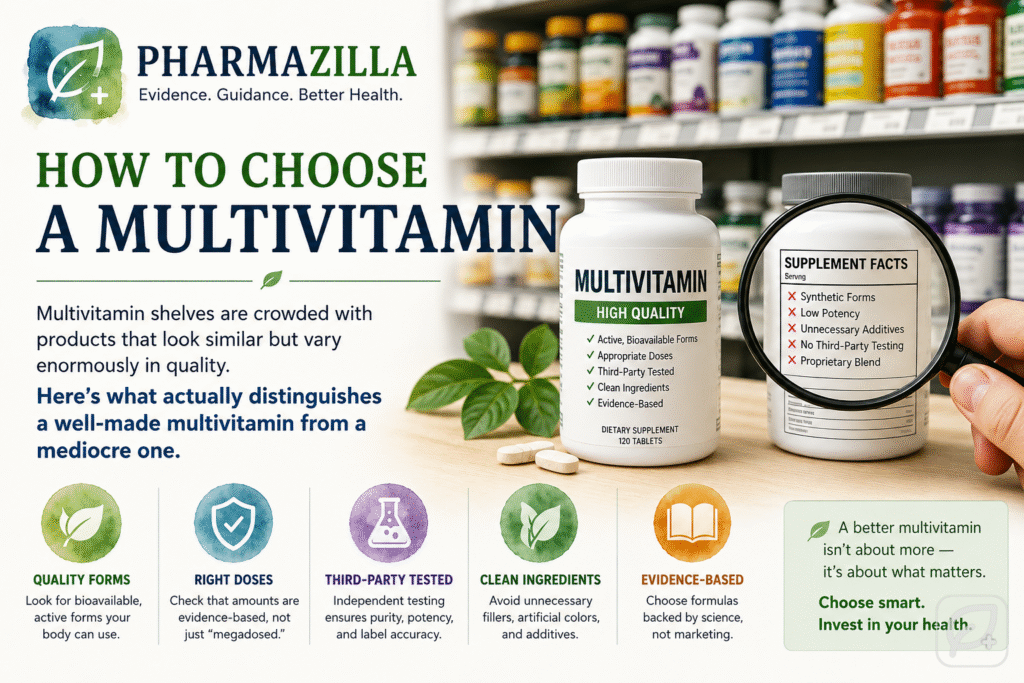
Multivitamin shelves are crowded with products that look similar but vary enormously in quality. Here’s what actually distinguishes a well-made multivitamin from a mediocre one.
First, a reality check on what a multivitamin can and can’t do. A multivitamin is best thought of as nutritional insurance to fill small dietary gaps — not as a shield against major disease. In 2024, an analysis of nearly 390,000 healthy U.S. adults followed for more than two decades found that daily multivitamin use was not associated with a lower risk of death (JAMA Network Open, 2024). Independent reviews have likewise found little evidence that multivitamins prevent heart disease or cancer in people who are already well-nourished. That doesn’t make them pointless — they can genuinely help if your diet falls short or you belong to a group with higher needs — but it does mean the aim is filling specific gaps, not buying the bottle with the longest ingredient list.
Check the ingredient forms, not just the names
Higher-quality multivitamins list the specific, more bioavailable form of each nutrient rather than a generic name — for example, “methylcobalamin” rather than just “vitamin B12,” or “cholecalciferol” instead of simply “vitamin D.” It’s also worth scanning for unnecessary fillers, artificial colors, or additives like excessive magnesium stearate or silicon dioxide that serve no nutritional purpose.
Dosage matters as much as ingredient quality
More is not automatically better. Fat-soluble vitamins — A, D, and E in particular — are stored in the body rather than excreted, so taking too much over time can lead to toxicity. Before choosing a formula, it’s worth asking a doctor or dietitian whether you actually need a multivitamin, and if so, which formulation fits your needs, especially if you take medications or have health conditions that could interact with certain nutrients.
Look for third-party testing
Dietary supplements aren’t reviewed by the FDA for effectiveness before hitting shelves the way medications are, which makes third-party certification the most reliable way to confirm a product actually contains what the label claims, free of harmful contaminants. Look for seals from these programs:
- USP Verified — confirms ingredient accuracy and manufacturing quality
- NSF Certified — tests for label accuracy and contaminants
- Informed Choice / Informed Sport — screens for banned substances, relevant for athletes
- ConsumerLab — independent testing and reviews across supplement categories
A product without any of these certifications isn’t necessarily bad, but a product that does carry one has passed an independent check most supplements never go through.
This article is researched and fact-checked against peer-reviewed studies and government health databases (NIH, FDA, PubMed). It is not written or reviewed by a licensed medical professional, and it is not a substitute for personalized medical advice — talk to your doctor or a registered dietitian before starting a new multivitamin, especially if you take medication or have a health condition. See how we review.
Sources: NSF: Dietary Supplement and Vitamin Certification, Healthline: How to Choose High Quality Vitamins and Supplements